When sourcing apparel for your business, one of the most common terms you’ll encounter is MOQ (Minimum Order Quantity).
Whether you’re a retailer, wholesaler, importer, startup fashion brand, or distributor, understanding MOQ can help you make smarter purchasing decisions and build stronger relationships with manufacturers.
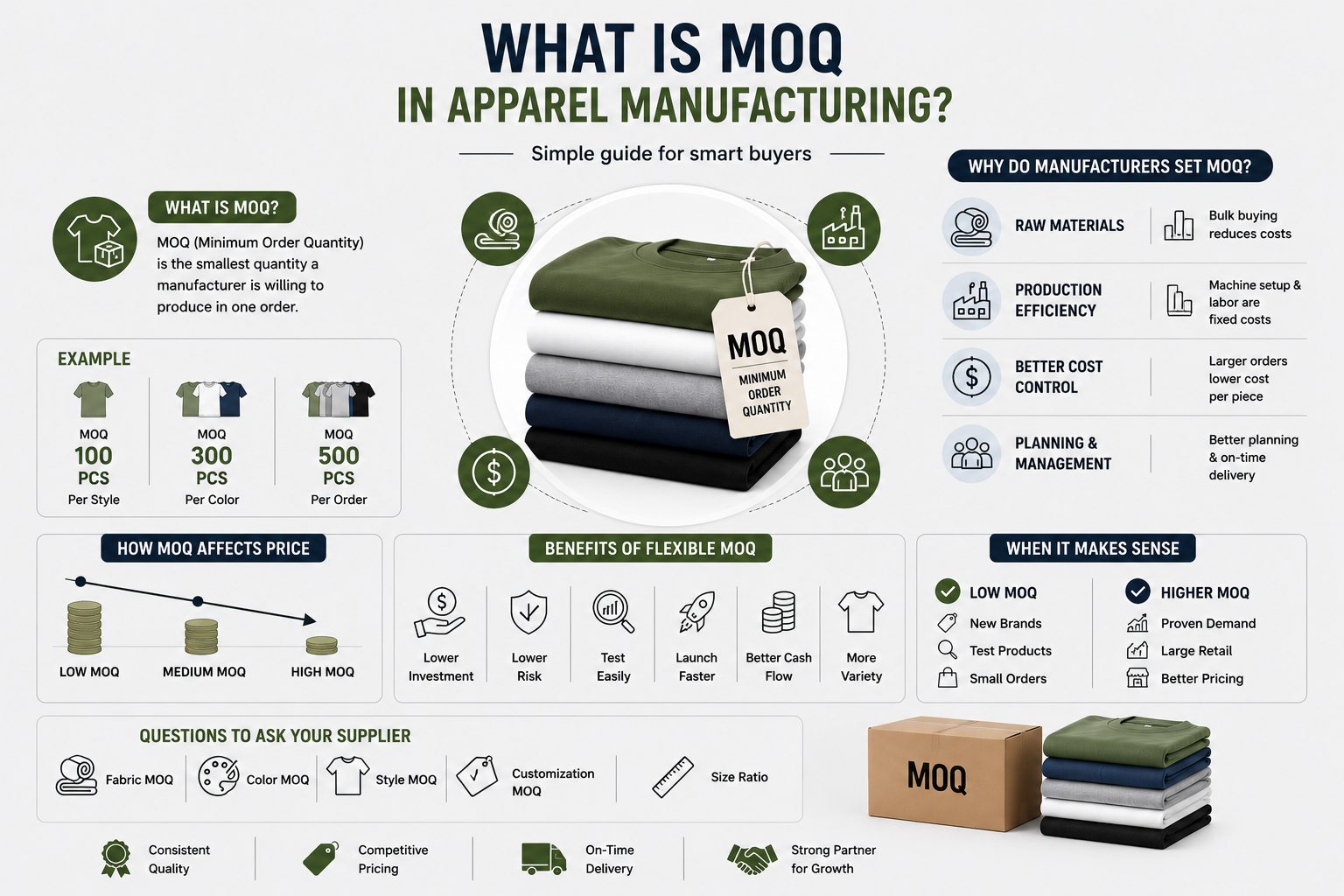
MOQ (Minimum Order Quantity) is the smallest quantity of products a manufacturer is willing to produce or supply in a single order.
For example:
This means the manufacturer requires at least that quantity to proceed with production.
MOQ is not simply a sales requirement.
It helps manufacturers manage production efficiently while maintaining quality and competitive pricing.
Factories often purchase fabric, trims, labels, and packaging materials in bulk quantities.
Very small orders can result in higher material costs.
Setting up machines, cutting fabric, printing, embroidery, and quality inspections all involve fixed costs.
Larger orders help distribute these costs more efficiently.
Producing larger quantities generally reduces the cost per piece, benefiting both manufacturers and buyers.
MOQ helps factories plan production schedules, labor allocation, and inventory more effectively.
In general:
| Order Quantity | Cost Per Piece |
|---|---|
| Low MOQ | Higher |
| Medium MOQ | Competitive |
| High MOQ | Lower |
Larger orders often receive better pricing because production and sourcing costs are spread across more units.
Many buyers, especially startups and growing brands, prefer suppliers that offer flexible MOQ options.
Low MOQ is ideal for:
It allows businesses to validate demand before committing to larger quantities.
Higher MOQ can be beneficial when:
In these cases, larger quantities can significantly improve profitability.
Before placing an apparel order, consider asking:
Is there a minimum fabric requirement?
Does each color require a separate MOQ?
Is MOQ applied per design or per order?
Are different MOQs required for:
Can sizes be mixed within the MOQ?
Understanding these details can help avoid surprises during production.
Customized apparel often requires higher MOQ because of:
However, many manufacturers now offer flexible solutions to support growing brands and smaller businesses.
A good apparel supplier should balance:
✅ Competitive pricing
✅ Consistent quality
✅ Flexible MOQ options
✅ Reliable delivery schedules
✅ Clear communication
The right manufacturing partner helps buyers scale their business while minimizing sourcing challenges.
MOQ is an important part of apparel manufacturing and sourcing. While larger quantities often reduce production costs, flexible MOQ options can provide valuable opportunities for startups, retailers, wholesalers, and emerging fashion brands.
Understanding how MOQ works allows buyers to plan inventory more effectively, manage budgets wisely, and build successful long-term supplier relationships.
At MJ Trendz, we support retailers, wholesalers, importers, distributors, and fashion brands with:
MOQ Explained, Minimum Order Quantity, Apparel Manufacturing, Garment Exporter, Clothing Manufacturer, Flexible MOQ, Apparel Sourcing, Fashion Brand Startup, Bulk Apparel Orders, T-Shirt Manufacturer, Garment Industry, Textile Manufacturing, Apparel Export Business, MJ Trendz Apparel, Clothing Production Guide.